
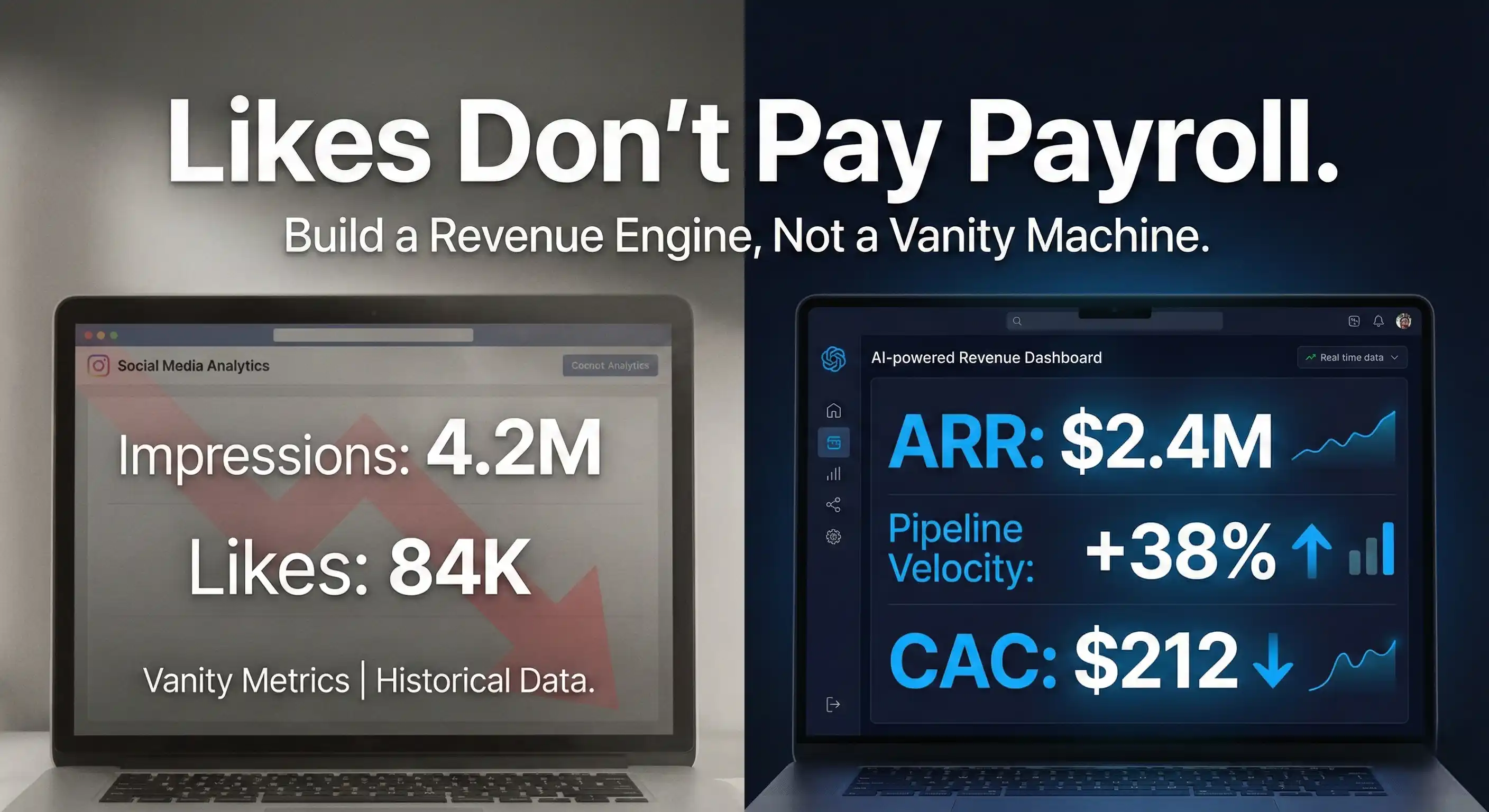
Something like this meeting happens that has now become boring in boardrooms across the country. A marketing agency arrives with a deck-colorful graphs, “impressions up 40%,” follower growth trending, posts reaching “significantly outperforming benchmarks.” Everyone nods. Then the CFO asks the one question that really matters: “So how much revenue did this generate?”
Silence.
If this scene sounds familiar, you're not alone - the problem isn't you. The problem lies with the industry that has spent decades training clients to celebrate false numbers.
Why “Good Engagement” Was Always a Blatant Lie
Vanity metrics - likes, impressions, reach, follower counts - aren't completely useless. They're just used incorrectly. Somewhere along the way, the marketing world started to value visibility, and agencies became so good at selling impressive dashboards that looked great but didn't move the revenue needle.
The stakes are much higher in 2026. Real estate enterprises, SaaS companies, and B2B firms can no longer hope to “build awareness” indefinitely. Payroll doesn't care about your engagement rate. Your CAC doesn't decrease because a post went viral.
What's shifting - and not slowly, quietly, but decisively - is that high-growth companies are stopping buying marketing and buying something fundamentally different: Predictive Revenue Architecture.
The name sounds technical because it is technical. But the core idea is simple: instead of broadcasting and sending messages to a wide audience, you build a system that identifies, scores, and engages the right people - before they raise their hands.
What AI is making possible wasn't possible five years ago.
Traditional digital marketing used to run on intuition and historical averages. Last quarter, see what worked, do a little A/B testing, and extrapolate. Educated guesswork in spreadsheets.
Machine learning turns this model on its head. When AI integrates with your CRM and ad infrastructure, you're not reacting - you're anticipating. Behavioral data, browsing patterns, third-party intent signals, email engagement timing, CRM activity gaps - all these inputs combine to create predictive models that assign a probability score to each lead.
The result? Sales teams stop wasting time on leads that are unlikely to close and instead spend their time on those that have a high chance of closing.

The 3-Step Enterprise Playbook That's Replacing "Spray and Pray"
Predictive Lead Scoring - Catching the Whales While They're Coming Up
Not all leads are equal. A sales rep with two years of experience will tell you. The problem is knowing if a lead is cold and identifying it quickly enough to prevent resource waste are two different things.
AI-powered lead scoring models analyze 40+ behavioral signals - not just job title or company size, but: How many times has the contact viewed the pricing page? Did they click to open the last three emails? Is they searching for a competitor product? What is the 30-day engagement velocity?
These patterns, when processed at scale, reveal intent more accurately than simple form fills or demo requests. Outcome: A tiered pipeline where the highest-value prospects are automatically routed to the right rep at the right time.For enterprise real estate firms, this could mean identifying a commercial buyer who is evaluating multiple properties without contacting anyone. For a SaaS company, this could mean catching an enterprise account about to expire before it renews.
Dynamic CAC Optimization - Stopping the Bleed in Real Time
One of the things that secretly destroys marketing ROI is budget momentum - money keeps flowing into campaigns and channels simply because it was running before, or because no one has noticed what's happening now.
Algorithmic bid management changes this at a speed and granularity that humans can't manually match. When AI connects to ad platforms, it doesn't optimize on a weekly reporting cycle. It adjusts bids, reallocates budgets, and pauses underperforming segments in near-real time - based on LTV projections, not just click-throughs.
Practical effect: Campaigns that were quietly burning through budget are stopped before the end of a quarter. High-LTV channels get more fuel while they perform. Blended CAC comes down because every rupee is being used more intelligently.This isn't theoretical. Companies implementing ML-driven budget optimization are routinely seeing 20–35% improvements in cost per qualified opportunity compared to traditional campaign management.
Automated Nurturing - Turning Cold Intent into Booked Meetings
The gap from “Interested” to “Ready to Buy” has always been a deal killer. The prospect downloads the whitepaper, gets put into a drip sequence, gets sent 7 generic emails over 6 weeks, and then unsubscribes. The lead was real. The nurturing was bad.
AI-driven nurturing sequences react to behavior, not calendar presets. If a prospect opens an enterprise pricing email at 11 pm on Tuesday, the next touchpoint shouldn't be “Email 4 of 7 - Here's a Case Study.” Rather, a personalized message that addresses their decision-making process, and it should be sent when they're more likely to engage.
Sophistication also extends to channel selection. Some prospects respond to LinkedIn messages, some to texts; high-performing revenue architectures map communication preferences individually and adjust accordingly-minimizing friction at each stage until the logical next step is to book a call.
Now the metrics that really matter
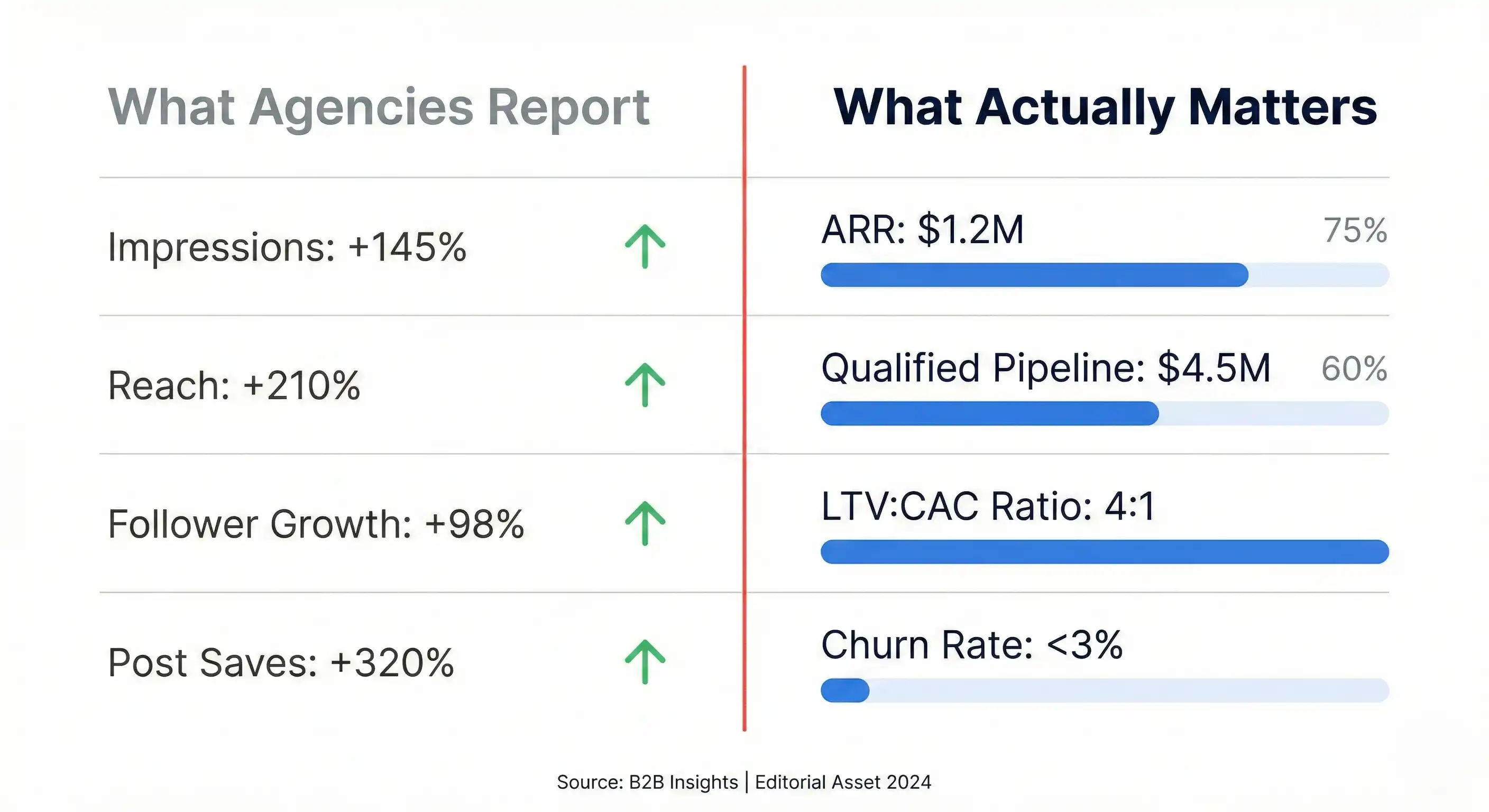
If you want a quick diagnostic of whether your current marketing setup is built for vanity or revenue, look at what agencies put on the first slide of your monthly report.
Whether it's reach, impressions, or follower growth-that's a signal. It's not necessarily that the agency is incompetent, but the system isn't wired for revenue accountability.
The metrics that Predictive Revenue Architecture reports will look different:
Pipeline velocity-How quickly are leads moving from MQL to closed-won?
Qualified opportunity rate-How many leads are actually worthy of a sales conversation?
Revenue-attributed CAC by channel-Not just cost per click, but how much ARR was generated from each channel and what was its cost?
LTV:CAC ratio-Are you acquiring customers cheaply enough to value them?
Churn prediction score - Are at-risk accounts being flagged before renewal?
These numbers tell the real story. They connect marketing activity to direct business outcomes. And they make it hard to hide behind the colorful graphs in the slide deck.

A Word on Implementation
The truth is that building a true revenue architecture isn't a plug-and-play solution. It requires clean CRM data, thoughtful integration work, and-most importantly-alignment between marketing, sales, and leadership on what "success" means.
Companies that do this right typically start with an audit: what data is already available, where are the gaps, and what signal-based decisions can replace gut-feeling decisions?
After that, build iteratively. Everything doesn't need to be perfect on Day One. What's needed is a foundation that delivers better intelligence than the last quarter-and that compounds over time.
Bottom Line
Agencies that are still selling impressions aren't necessarily bad. They're simply selling products from an era when attention was scarce and brand awareness was hard to come by.
That era is over. Attention is cheap. Intelligence is the only resource available.
Enterprises that understand this early-those that stop vanity fundraising and build revenue engines-will not only outperform this quarter. Their models will become smarter, their pipelines will become cleaner, and their CAC will continue to fall-a compound advantage will emerge.
The question isn't whether AI fits into your revenue strategy. The question is whether you can afford to wait until your competition has already figured this out.